The history
The Huguenots and the church on the Gendarmenmarkt
How a 1685 edict brought French Protestant refugees to Brandenburg-Prussia, and how they came to build a church whose domed tower now fronts a concert.
Book the concert ↗Quick answer
The church on the Gendarmenmarkt exists because of a decision made in 1685. When Louis XIV revoked the Edict of Nantes, the Elector of Brandenburg issued the Edict of Potsdam on 29 October 1685, inviting French Protestants to settle in his lands, and the French church was built for their Berlin community between 1701 and 1705. The domed tower came later, in 1785.
Two edicts in 1685
English Wikipedia says Louis XIV issued the Edict of Fontainebleau in 1685, revoking the Edict of Nantes and declaring Protestantism illegal. Huguenots, French Calvinists, left in large numbers for Protestant countries. The Great Elector of Brandenburg answered quickly. The article on the Edict of Potsdam says Frederick William, Elector of Brandenburg and Duke of Prussia, issued it in Potsdam on 29 October 1685, and the pairing of the two edicts is the starting point of everything below.
What the Edict of Potsdam offered
According to the same article, the refugees could choose where to settle, were exempt from customs duties on the assets they brought and received housing in abandoned properties with building materials supplied at no cost. They were offered a six-year exemption from property taxes, freehold farmland in some areas, full legal and civic equality, and permission to hold church services in French and to run their own schools. The article gives the number who relocated to Brandenburg-Prussia in response as approximately 20,000. It does not give a figure for Berlin alone.
A community large enough to need a church
English Wikipedia's article on the French Cathedral says the Huguenots made up about 25 percent of the city's population at the time the church was built. Whether that precise share holds for every year of the period is a matter for historians, but the effect is clear: a French-speaking Calvinist congregation needed a place to worship in its own language, and the edict had promised it one.
Building the church
Louis Cayart and Abraham Quesnay built the first parts between 1701 and 1705, with the infobox giving 1 March 1705 as completion. The article says it was modelled on the destroyed Huguenot temple at Charenton-Saint-Maurice in France. The formal name is the French Church of Friedrichstadt, and the congregation was Calvinist and Huguenot in origin. It joined the Evangelical Church in Prussia in 1817 but kept its Calvinist denomination, and the building has been United Protestant since its reconstruction in 1981.
The dome, added in 1785
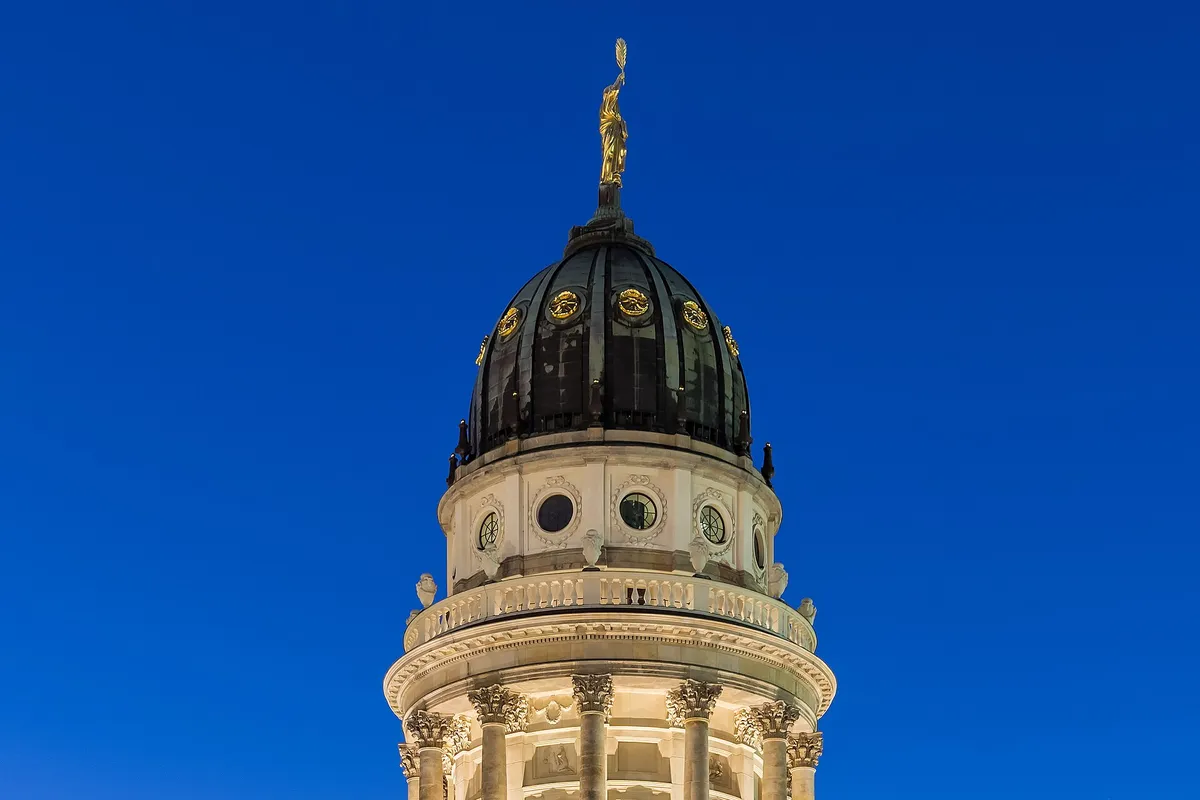
The part that gave the church its nickname came much later. Wikipedia says Carl von Gontard modified the church and added the domed tower in 1785, prompted by Frederick the Great, who wanted to embellish the Gendarmenmarkt. The same article notes that the tower is technically separate from the church and has different proprietors. The word Dom in the common name comes from dôme, not from a bishop's seat, which is why the building is not a cathedral despite what the English name suggests.
War, rebuilding and use today
English Wikipedia says the church was severely damaged in the Second World War and was rebuilt between 1977 and 1981 by Manfred Prasser, Roland Steiger and Uwe Karl. The domed tower houses the Berlin Huguenot museum and has a public observation deck, according to the same article, though opening details change and are not given here. The church itself, now a Protestant place of worship, also hosts concerts, which is where the 65-minute evening on the booking page comes in.
What this means for the concert
The music stands without any of this background. But a Huguenot church from the early 1700s, rebuilt after wartime damage, gives the evening a depth that a modern hall cannot. If you want more, the French Cathedral's tower and museum are separate from the concert and are best checked on their own pages. Everything on this page comes from Wikipedia's articles, so check a church or museum website for current opening details before you plan around them.
Frequently asked questions
Is the church still Huguenot?
It is United Protestant since its 1981 reconstruction, according to English Wikipedia.
Is the tower part of the concert?
No. The booking page describes the concert only, and the tower and museum are separate.
When was the church built?
Between 1701 and 1705, says Wikipedia; the domed tower followed in 1785.
Sources